

5 Best Virtual Business Cards for Ad Spend in 2026

Your card hit its limit mid-campaign. Or a billing error on a shared card paused three clients at once. Or you spent four hours at month-end trying to match bank statement lines to platform charges. These are not edge cases for businesses running serious ad spend; they are what happens when the wrong card is doing a job it was not built for.
The right card clears reliably on Meta, Google, and TikTok; scales its limit with your campaigns rather than your credit profile; lets you issue one card per client and per platform; and connects reconciliation to the transaction level. For businesses where advertising is the primary expense, Opal is built to clear all four: spend-based limits up to $10M, up to 2% cashback on eligible ad spend, no annual fee, no personal guarantee, and unlimited virtual cards.
This guide covers the five strongest options in 2026, what separates them, and how to choose based on your volume and business type.
TL;DR
Opal is the strongest fit when advertising is your primary spend category. Slash leads on card controls. Brex and Ramp work when ad spend is one line item in a broader finance stack. Mercury IO suits businesses that want banking and cards in one place.
Quick Comparison: 5 Best Virtual Cards for Ad Spend
|
Card |
Credit Limit |
Cashback on Ad Spend |
Virtual Cards |
Personal Guarantee |
Best For |
|---|---|---|---|---|---|
|
Opal |
Up to $10M, spend-based |
Up to 2% on eligible ad spend |
Unlimited |
No |
Agencies, media buyers, DTC brands |
|
Slash |
Tied to business financials |
Up to 2% uncapped (Pro plan) |
Unlimited |
No |
Agencies prioritizing card controls |
|
Brex |
Cash-balance based |
1x points standard (about 0.6% as cash); 1.5x on some tiers |
Unlimited |
No |
Venture-backed companies |
|
Ramp |
Tied to business financials |
Up to 1.5% (subject to program terms) |
Unlimited |
No |
Ad spend as one line item among many |
|
Mercury IO |
Balance-informed |
1.5% unlimited |
Unlimited |
No |
Banking and cards in one place |
Scope: Business and corporate virtual cards only. No crypto-funded or no-KYC prepaid cards. Each provider was assessed on virtual-card issuance, spend controls, funding structure, rewards, reconciliation, and paid media fit.
What Makes a Virtual Card Actually Work for Ad Spend?
A virtual card works for ad spend when it clears on major ad platforms, scales its limit with campaign budgets, supports unlimited card issuance for client and campaign isolation, and connects reconciliation to the transaction level. Most general business cards fail at least two of those four criteria.
The Four Requirements That Actually Matter
1. BIN acceptance on Meta, Google, and TikTok
BIN acceptance is whether an ad platform's payment system clears a card based on its Bank Identification Number: the first six to eight digits identifying the issuing bank and card type. Account history, billing details, and available balance also factor in. No provider guarantees universal acceptance. Test any new card on a small account before moving full campaign volume. For a platform-by-platform breakdown, see how ad platforms bill and what triggers payment failures.
2. Credit limits that scale with campaign budgets, not a credit profile
General business cards set limits based on credit history, which creates a structural problem for media buyers: your limit was set when you were spending half what you spend today. Opal sizes limits around actual ad spend volume, so capacity grows with campaigns rather than capping mid-month.
3. Unlimited virtual cards for client and campaign isolation
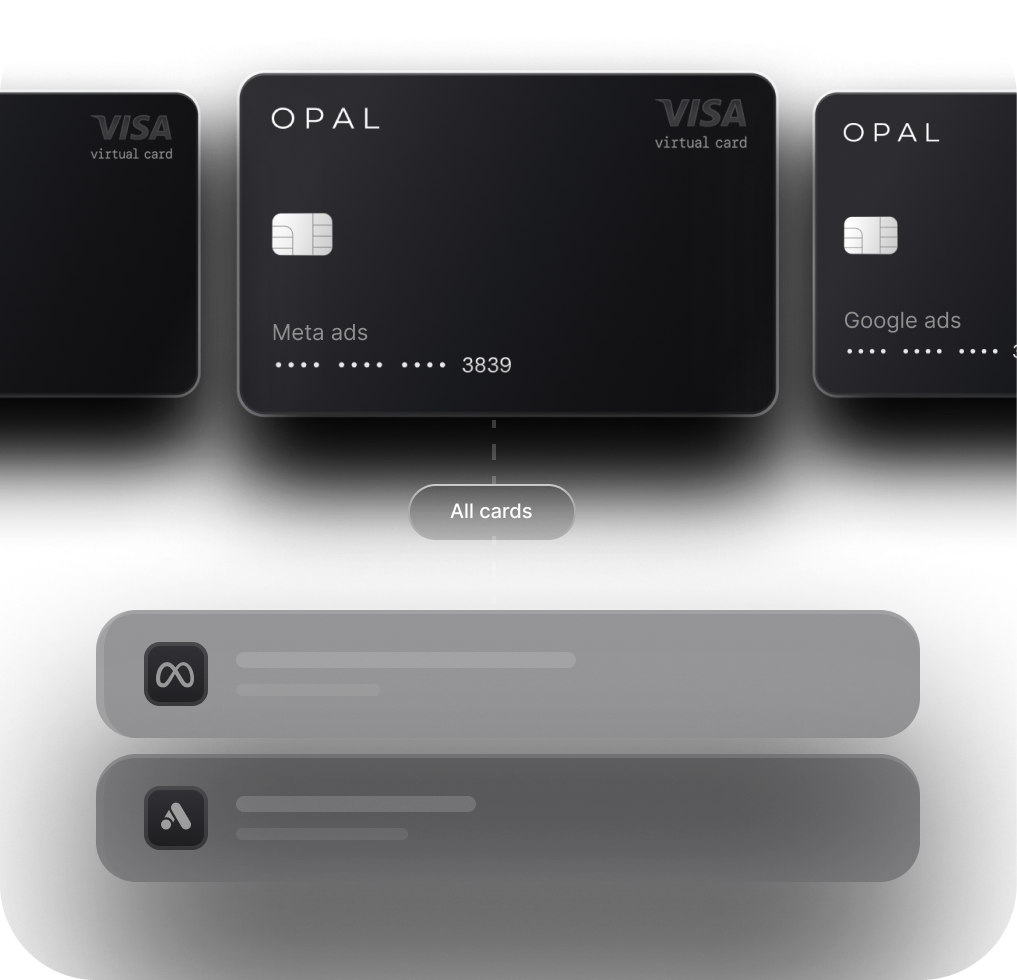
One card per client, per platform is the cleanest structure. A billing failure on a virtual card only affects the ad accounts attached to that specific card. A single shared card removes that separation entirely. With multiple clients in the mix, this distinction determines whether a payment issue on one client's Meta account pauses everyone else's campaigns.
4. Reconciliation at the transaction level
Month-end reconciliation across five clients and four platforms, using only a bank statement, costs your finance team hours that stack up fast and never get easier. Cards with real-time spend visibility by platform and campaign eliminate that work. See how to automate ad spend reconciliation for a step-by-step breakdown.
Why Cashback Caps Matter More Than the Headline Rate
The Amex Business Gold earns 4x Membership Rewards points on your top two spending categories each billing cycle, drawn from six eligible categories that include purchases at U.S. media providers for advertising in select media. The 4x applies to the first $150,000 in combined purchases from those two categories per calendar year ($12,500 per month), so a business spending on ads plus software reaches the ceiling faster than ad spend alone suggests. Above that threshold, the rate drops to 1x for the remainder of the year. For anyone spending $15,000 or more per month on advertising, the effective annual return drops sharply once the cap is hit. Points cards also require a redemption step, making them harder to forecast than flat cashback at volume. For the full breakdown, see how cashback caps quietly limit ad spend rewards.
What Actually Determines How Much You Can Spend?
The funding model underneath a virtual card determines how much you can spend and whether that limit scales with your campaigns. A virtual card is just a card number, expiration date, and CVV; the format tells you nothing about where the money comes from. Four different funding models sit underneath virtual cards, and the model determines whether your limit keeps up with your campaigns.
|
Funding Model |
How Capacity Is Set |
Examples |
|---|---|---|
|
Ad-spend charge card |
Based on ad spend patterns and cash flow; balance due in full each cycle |
Opal |
|
Daily-settlement charge card |
Balance settled daily; capacity informed by business financials and banking layer |
Slash |
|
Balance-informed corporate credit |
Credit limit informed by total account balance |
Mercury IO |
|
General corporate credit |
Based on business credit profile, revenue, and financials |
Brex, Ramp |
|
Debit / prepaid |
Constrained by preloaded balance |
Prepaid providers |
Deposit-backed and prepaid models require cash on hand before you spend. Credit and charge-card models extend capacity based on spend patterns, so limits scale with campaigns. When a budget doubles mid-month, the funding model determines whether your card keeps up or your campaigns pause. For a detailed breakdown at $50K+ monthly spend, see charge card vs. credit card for high ad spend.
The 5 Best Virtual Business Cards for Ad Spend in 2026
1. Opal: Best Overall for Advertising Spend
Opal is the only card on this list built exclusively for ad spend. It is a pay-in-full charge card with limits up to $10M, sized on monthly ad spend and cash flow rather than a generic credit assessment. The full balance is debited monthly from the designated bank account or Opal Balance.
What Opal offers
Up to 2% cashback on eligible ad spend across Meta, Google, TikTok, Snapchat, LinkedIn, Amazon Ads,Trade Desk, and more
No annual fee, no personal guarantee, no credit check
Unlimited virtual cards with real-time ad spend visibility at the transaction level
Reconciliation built for paid media: one card per client, per campaign, or per platform
U.S.-based businesses only
The cashback math at volume
|
Monthly Ad Spend |
Monthly Cashback (up to 2%) |
Annual Cashback |
|---|---|---|
$50,000 |
Up to $1,000 |
Up to $12,000 |
$100,000 |
Up to $2,000 |
Up to $24,000 |
$250,000 |
Up to $5,000 |
Up to $60,000 |
$500,000 |
Up to $10,000 |
Up to $120,000 |
At $100K per month, the difference between a capped points card reverting to 1x and an uncapped up to 2% cashback card is up to $16,800 per year. That is a month of creative production, not a rounding error.
The honest limitation
Opal is not a general expense card. If you need one card for software, travel, and advertising, look at Ramp or Brex. Opal is built for businesses where ad spend is the primary expense category. Learn how Opal works.
2. Slash: Best for Virtual Card Controls
Slash earns up to 2% cashback on the Pro plan with no cap, and up to 1.5% on the Free plan. Its main strength is the depth of card controls: per-card limits, merchant and MCC restrictions, country and transaction rules, card groups, and group-level spending rules. Slash has the strongest card control feature set in this comparison, specifically for teams that need to govern how individual cards behave across clients and campaigns.
Key details
Pro plan: up to 2% cashback, $25/month; Free plan: up to 1.5%, $0/month
Unlimited virtual cards, no personal guarantee
Daily settlement: balance clears each day, not at month-end
The structural gap
Slash cards settle daily, which means your balance clears every 24 hours rather than monthly. At scale, that daily cadence ties up working capital continuously rather than freeing it up once per billing cycle. The controls are genuinely strong; the settlement structure is the tradeoff. The Opal vs. Slash comparison breaks down how that daily cadence affects working capital at different spend levels.
3. Brex: Best When Ad Spend Is Part of a Broader Finance Stack
Brex works when ad spend sits inside a broader financial stack alongside expenses, bill pay, and accounting integrations. Credit limits are based on cash balance rather than personal credit, which makes it accessible to venture-backed companies without an established credit profile. Capital One completed its $5.15 billion acquisition of Brex in April 2026. What that means for Brex's rewards and underwriting is still playing out.
Key details
Daily-pay Advertising product earns 1.5X on eligible ad spend
Standard monthly-pay structure earns 1x on ad spend
Unlimited virtual cards, no personal guarantee
Worth knowing at scale
The standard monthly-pay product earns 1x on ad spend. At $100K per month, that is a $16,800 annual difference compared to an uncapped 2% card. If most of your spend is paid media rather than general expenses, that $16,800 annual gap is a meaningful budget line by mid-year. See Opal vs. Brex for the full breakdown.
4. Ramp: Best for General Expense Management
Ramp pays up to 1.5% cashback on eligible spend with no ad spend category premium. A buyer running $200K per month on Meta earns the same rate as office supplies. Credit limits are tied to business financials.
Key details
Up to 1.5% cashback across all categories (no ad spend multiplier)
Unlimited virtual cards, no personal guarantee
Strong expense management and accounting integrations
Where it fits and where it doesn't
Ramp is a strong choice when ad spend shares the budget with payroll, software, and travel. The flat rate works in that context. Where it breaks down is when advertising is the dominant category. A buyer at $200K per month leaves up to $12,000 per year on the table versus a card built around ad spend, and gets no reconciliation tooling designed for platform-level attribution. See the Opal vs. Ramp comparison.
5. Mercury IO: Best When Banking and Cards Need to Be in One Place
Mercury IO offers unlimited 1.5% cashback, no personal guarantee, unlimited virtual cards, card-level spend controls, and integrations with QuickBooks, Xero, and NetSuite. Teams that want banking, corporate cards, and expense controls under one roof will find Mercury IO more capable than its reputation in ad spend circles suggests.
Key details
1.5% unlimited cashback on all spend
Credit tied to company balances rather than campaign throughput
No personal guarantee, no minimum balance required
The underwriting mismatch
Mercury IO's credit model rewards companies that hold large balances, not companies that scale spend fast and run campaigns hard. A fast-growing DTC brand scaling from $50K to $200K per month may find its limit lags its actual spend trajectory. At that inflection point, the banking integration is useful. The credit model is the constraint. See the full Opal vs. Mercury comparison.
Note on Parker: Parker previously served DTC ecommerce brands with revenue-linked credit limits. Parker filed for bankruptcy and shut down in May 2026 and is no longer an active option.
How to Choose the Right Virtual Card for Your Situation
By Monthly Spend Volume
Under $10K per month: The cashback gap is not material enough to drive the decision. Ramp or Mercury give you virtual cards and basic controls without a dedicated ad spend card. Start there and revisit when volume grows.
$10K to $50K per month: Card selection starts to have real financial consequences. A capped category multiplier will underperform an uncapped cashback card within a few months. Slash works if granular controls are the priority. If ad spend is your primary category, Opal's spend-based underwriting is worth evaluating before limits become a constraint.
$50K or more per month: The difference between up to 2% on eligible ad spend and a capped points program adds up to tens of thousands per year. Campaign interruptions from hitting a limit cost more than the limit itself. Automating ad spend reconciliation stops being optional at this volume. See the ranked guide for high-volume media buyers for a scored comparison.
By Business Type
|
Business Type |
Primary Need |
Starting Point |
|---|---|---|
Media buying agency (multi-client) |
Per-client card isolation, platform-level attribution |
Opal |
DTC brand (in-house team) |
Spend-based limits, platform-level visibility |
Opal |
Performance marketer (high volume) |
High limits, uncapped cashback, no personal guarantee |
Opal |
Business where ad spend is one line item among many |
Flat cashback across all categories |
Ramp |
Business wanting banking and cards together |
Integrated banking and corporate card ecosystem |
Mercury IO |
What Card Failure Actually Costs
A Meta campaign paused mid-flight during a product launch loses impressions that cannot be recovered, and the algorithm resets. Restarting a paused campaign typically costs 3 to 5 days of re-learning before performance returns to pre-pause levels. At $10,000 per day in spend, a two-day pause from hitting a card limit costs more in lost efficiency than a year of cashback difference between any two cards on this list. Choose the card that keeps campaigns running first; optimize the earn rate second.
How Should Agencies Structure Virtual Cards for Ad Spend?
The card you choose matters less than how you deploy it. For solo media buyers and in-house teams, one card per platform is usually enough. For agencies managing multiple clients, the structure below determines whether a billing issue on one client's account stays contained or cascades across the rest.
Four common architectures exist, each with different tradeoffs on attribution, billing isolation, and management overhead.
|
Structure |
Attribution |
Billing Isolation |
Management Overhead |
|---|---|---|---|
One shared card |
None |
None |
Minimal |
One card per platform |
Platform-level |
Platform-level |
Low |
One card per client |
Client-level |
Client-level |
Medium |
One card per client + platform |
Full granularity |
Full granularity |
Higher |
One card per client per platform is the strongest structure. Every charge is attributed at the transaction level, billing failures stay isolated, and reconciliation runs automatically. The only real work is keeping your naming convention consistent. There is no financial reason to consolidate.
For ten clients running on Meta, Google, and TikTok, that is thirty cards. With unlimited virtual card issuance and no per-card fees, setup is fast and the ongoing overhead is minimal. Fewer cards mean faster initial setup but messier reconciliation and more concentrated payment risk.
-
See how agencies structure ad spend by client for the three-model breakdown
-
See managing ad spend across 50+ clients for the playbook at scale
Frequently Asked Questions
What is the best virtual card for high-volume ad spend?
For businesses where advertising is the primary expense category, Opal is the strongest option: spend-based limits up to $10M, up to 2% cashback on eligible ad spend, no personal guarantee, no credit check, no annual fee, and unlimited virtual cards. For operations that prioritize granular card controls above limit size, Slash is the main alternative. For companies where ad spend is one line item among many, Ramp offers up to 1.5% flat-rate cashback across all spend.
Should a media buyer or agency use one virtual card per client or per ad account?
One card per client per platform is the cleanest setup. You get client-level attribution, contained payment risk per platform, and reconciliation that runs without manual sorting. One shared card across all clients creates commingled spend that is hard to unwind if a client disputes charges or offboards.
What is the difference between a virtual credit card, charge card, and prepaid virtual card?
All three are virtual cards, but the funding model differs. A virtual credit card draws on a revolving credit line. A charge card requires the full balance each cycle, with no revolving option. A prepaid virtual card is funded by a balance you load in advance. For ad spend, the distinction affects how much capacity you have and whether limits scale with your campaigns.
What is the best virtual card for Facebook Ads?
For Facebook and Instagram ad spend, three things matter: a card that clears Meta's payment systems reliably, a limit structure that handles Meta's billing threshold model without hitting a ceiling mid-month, and card-level separation so a billing issue on one account does not affect others. Opal meets all three. The full guide to the best credit card for Facebook Ads covers the billing threshold mechanics in detail.
What should I look for in a virtual card for Google Ads?
Three factors matter most: a credit limit that absorbs Google's billing threshold model without hitting a ceiling mid-month, reliable authorization on Google's payment systems, and card-level attribution so Google charges stay separated from other platform spend. If Google Ads is your primary platform, read the guide to high-limit cards for Google Ads before committing to a card.
Bottom Line
The card that earns the most on paper is useless if it pauses your campaigns mid-month. At volume, limit headroom, billing reliability, and clean reconciliation matter more than a headline rate or a brand name on the physical card.
When advertising is your primary spend category and monthly budgets are substantial, a card built around ad spend infrastructure gives you more capacity, cleaner reconciliation, and cashback that does not cap out mid-year. If ad spend is one line item alongside payroll and software, or volume is still growing, a general corporate card with virtual card support is a reasonable starting point.
Before choosing, ask:
Does the limit structure scale with my campaign budgets, or will it cap out mid-month?
Is the cashback rate uncapped, or does it revert after an annual ceiling?
Can I issue one virtual card per client and per platform without extra fees?
Does reconciliation happen automatically, or does someone sort it manually at month-end?
For most businesses where advertising drives the majority of monthly spend, the card that answers all four questions correctly is Opal. See what Opal returns on your current ad spend volume.