

How The Trade Desk Bills Agencies (and Why Your Card Setup Has to Match)


The Trade Desk invoices agencies on Net-45 terms, runs a credit check before any campaigns can launch, charges a 3% convenience fee on credit card payments, and can suspend platform access if an invoice goes unpaid for more than 5 days after a nonpayment notice. That is the billing reality for any agency running programmatic through TTD's self-serve platform.
Most agencies find this out the hard way. The platform feels like a media tool, but the payment relationship is a credit relationship. Understanding the mechanics before you run your first campaign is the difference between a smooth operation and a cash flow scramble that takes down live campaigns.
Key Takeaways
Key Takeaways
TTD invoices on Net-45 terms from the invoice date, billed in USD
A credit check is required before launching any campaigns, and TTD can recheck at any time
Credit card payments carry a 3% convenience fee, added automatically
Unpaid invoices accrue 2% monthly interest after the due date
TTD can suspend platform access if an invoice is overdue; termination follows within 5 days of a nonpayment notice
Agencies can request a Bill-To Entity to route invoices to a client or third party, but remain legally responsible for payment
The right card setup eliminates the cash flow gap TTD's terms create
How Does The Trade Desk Actually Bill Agencies?
TTD operates a self-serve DSP model. Agencies access the platform under their own agreement, run campaigns on behalf of clients, and receive invoices directly from TTD for all media spend and fees incurred.
Per TTD's advertising terms, the key billing terms are:
-
Invoice currency: USD by default. Non-USD billing can be requested in writing before account creation, subject to TTD's approval, and cannot be changed afterward.
-
Payment terms: Net-45 from the invoice date. The full invoice amount is due within 45 days.
-
What gets invoiced: Total Cost, which TTD defines as Media Spend (all ad inventory and data licensed through the platform) plus any applicable Fees.
-
Credit card payments: If you pay by card, TTD adds a 3% convenience fee to the invoice total. This is non-negotiable and automatic.
Media Spend covers all ad inventory purchased and all data licensed through the platform on your behalf or on behalf of your clients. If your campaigns use third-party audience segments, those data costs are bundled into the invoiced amount alongside the raw inventory cost.
What Happens If You Pay Late?
This is where TTD's terms get serious. Missing the Net-45 window triggers a cascade of consequences laid out in the platform's advertising terms:
-
Interest accrues immediately. TTD charges 2% per month (or the maximum allowed by law, whichever is lower) on any unpaid balance past the due date.
-
Platform access can be suspended. TTD reserves the right to suspend your access to the platform and all services for any overdue invoice, even a small one.
-
Termination follows fast. If you receive a nonpayment notice and do not pay the overdue invoice in full within 5 days, TTD can terminate the agreement entirely.
The 5-day window is the number to internalize. It is not 30 days. It is not a grace period in the traditional sense. Once TTD sends a nonpayment notice, you have 5 days before the entire relationship is at risk.
For agencies running live campaigns across multiple clients, a suspension does not just affect one account. It affects every campaign running under that partner-level agreement. Every client running campaigns under that agreement loses access at the same time.
Does The Trade Desk Run a Credit Check on Your Agency?
Yes, and it is a prerequisite, not a formality. TTD's terms state that agencies are subject to a credit check before initiating any campaigns on the platform. TTD also reserves the right to run additional credit checks at any point during the term of the agreement and to adjust the credit extended to the agency at any time.
This has two practical implications:
-
You cannot launch campaigns until the credit check clears. If you are onboarding a new TTD seat to service a client, factor in the time this takes.
-
Your credit line can change mid-campaign. TTD can reduce the credit it extends to your agency at any time. If your campaigns are running at or near your credit limit, a mid-cycle reduction could create problems.
The credit check applies to the agency, not the client. Even if a client has pre-funded their media budget, the agency's creditworthiness determines platform access. This is a structural mismatch that the right card infrastructure can resolve.
Can You Route TTD Invoices to a Client Instead of Paying Directly?
TTD does allow this, with an important catch. The platform's terms include a "Bill-To Entity" provision: an agency can request in writing that invoices be sent to a different entity, such as a client or a holding company, rather than to the agency directly.
Here is how it works in practice:
What changes |
What stays the same |
|---|---|
Invoices are sent to the Bill-To Entity |
The agency remains the "Sold To" on every invoice |
The Bill-To Entity makes the payments |
The agency remains legally responsible for payment |
Billing starts on the first day of the calendar month after TTD approves the request |
TTD must approve the request before it takes effect |
The critical line in TTD's terms: the agency "remains responsible for performance of all Company's obligations under the Agreement (including payment)" and it is the agency's responsibility to ensure the Bill-To Entity pays on time.
Bottom line: if your client fails to pay TTD on time, TTD looks to you. The Bill-To Entity arrangement changes who receives the invoice, not who is on the hook for it. Your agency's relationship with the platform depends on that invoice getting paid, regardless of who you have designated to pay it.
Why the 3% Credit Card Fee Is a Structural Problem, Not Just a Cost
Most agencies default to paying TTD invoices by credit card because it is the path of least resistance. It is also the most expensive path at scale, and it creates a second problem beyond the fee itself.
The Fee Compounds Across Clients
If you are managing five clients each spending $50,000 per month on TTD, your combined monthly invoice is $250,000. The 3% convenience fee adds $7,500 to that invoice every single month, or $90,000 per year, paid purely for the privilege of using a card. That is not a rounding error.
The Card Has to Be Set Up Before the Invoice Arrives
The second problem is timing. TTD invoices on a monthly cycle. If the card on file for your TTD account is not purpose-built for high-limit ad spend, you risk a declined payment when a large invoice hits. A decline on a TTD invoice starts the late-payment clock immediately.
The card architecture you set up before campaigns go live determines whether you can pay TTD invoices cleanly, at scale, without interruption. How you structure ad spend by client is where that decision starts.
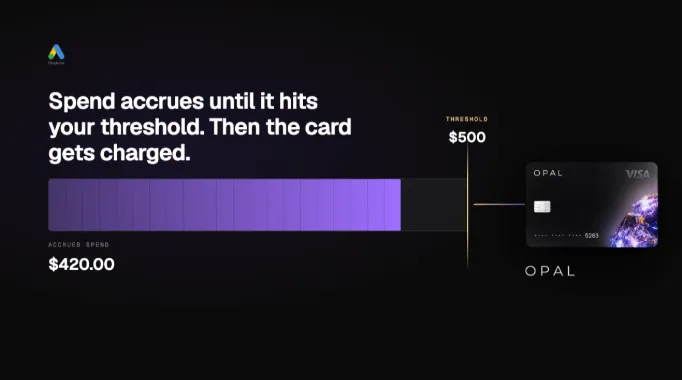
The practical rule: your card limit for TTD spend should be sized to cover at least one full monthly invoice cycle, with buffer for mid-month threshold charges. Agencies that size their card limits to match client budgets, not just average spend, avoid the declined-payment scenario entirely.
How to Align Your Card Infrastructure With TTD's Billing Cycle
When TTD's invoice arrives, you pay it on time, with a card that can handle the amount, without using your agency's working capital to bridge the gap.
The client-funded card model is the architecture that solves this directly. The structure works like this:
-
Client pre-funds their media budget before campaigns run. The funds sit on a dedicated card, not in the agency's operating account.
-
One card per client is issued and put on file with TTD (and every other platform that client uses). When TTD invoices, the charge hits that client's card, not a shared agency card.
-
The agency never bridges the gap between when TTD invoices and when the client pays. The money is already there.
This matters because of TTD's Net-45 window. Under a standard agency billing model, an agency might invoice its client on Net-30 terms, but TTD invoices the agency on Net-45. That timing mismatch creates a float problem: the agency owes TTD before the client has paid the agency. The client-funded model eliminates that mismatch entirely.
Agencies using a purpose-built ad spend card also earn up to 1.5% cashback on TTD spend, with no category caps. At $250,000 a month in TTD spend, that is up to $3,750 back every month.
Get set up at opalspend.com before your next campaign goes live.
Frequently Asked Questions
What are The Trade Desk's payment terms for agencies? TTD invoices agencies on Net-45 terms from the invoice date. Payment is due in full within 45 days. Invoices are denominated in USD by default, and the full amount must be paid without setoff or deduction.
Does The Trade Desk charge a fee for credit card payments? Yes. TTD adds a 3% convenience fee to any invoice paid by credit card. The fee is applied automatically and is non-negotiable. Agencies paying large monthly invoices by card should factor this cost into their client billing structure.
Can The Trade Desk suspend my account for a late payment? Yes. TTD can suspend platform access for any overdue invoice. If TTD sends a nonpayment notice and the invoice is not paid in full within 5 days, TTD can terminate the agreement. All campaigns running under the affected partner-level account would be impacted.
Does The Trade Desk run a credit check on agencies? Yes, before any campaigns can launch. TTD reserves the right to run additional credit checks during the term of the agreement and to adjust the credit extended to the agency at any time.
Can I have TTD invoice my client directly? You can request a Bill-To Entity arrangement, which routes invoices to a client or third party. However, the agency remains legally responsible for payment. If the Bill-To Entity fails to pay on time, TTD holds the agency accountable.
What is the best card setup for paying TTD invoices? A purpose-built ad spend card with a high limit, issued per client, and pre-funded by the client before campaigns run. This eliminates the cash flow gap between when TTD invoices the agency and when the client pays, so the card on file is always ready to cover the full invoice amount.