

How to Set Up Client Ad Spend Billing Before Your First Campaign


To bill clients for ad spend before your first campaign, choose a billing model, keep the client as the ad account owner, and document budget approval, payment controls, and invoice terms before launch. Without these decisions in place, agencies typically face avoidable approval delays, billing questions, and cash flow exposure.
This guide walks through each decision in order: billing structure, account ownership, the six-item pre-launch checklist, and invoice format. Make these calls before the first dollar is spent and most of the friction that shows up later never does.
For reconciliation depth, see the linked guides throughout. For how Meta, Google, TikTok, and other platforms actually bill in 2026, see the ad platform billing mechanics guide.
Key Takeaways
Decide on your billing structure before onboarding: client-paid direct, agency-paid-and-invoiced, or client-funded each carry different cash flow and accountability profiles.
The client should own the ad account. The agency manages access and the payment method.
Six items need written confirmation before launch: approved budget, replenishment trigger, platform access, spend limits, backup payment method, and approval authority.
Invoices must separate media spend, management fees, and credits as distinct line items.
A dedicated virtual card per client per platform, with a hard limit matching the approved budget, enforces spend controls without manual oversight.
How Should Agencies Bill Clients for Ad Spend?
Agencies use three billing models: client-paid direct, agency-paid-and-invoiced, and client-funded. Choose one before onboarding. The model you pick determines who carries financial exposure and how invoices are structured from day one.
There are three billing models agencies use:
Client-Paid Direct
The client connects their own payment method to each ad platform. The agency manages the account and campaigns, then bills separately for management fees. The client sees platform charges on their own statement.
Best for: Clients with in-house finance teams or those comfortable managing platform billing directly. Zero cash flow exposure for the agency.
Watch out for: A declined card mid-campaign. Platforms auto-pause when payment fails, and that pause often lands at the worst possible moment.
Agency-Paid-and-Invoiced
The agency puts its own card on the platforms, runs spend, then invoices the client for media costs plus the management fee in a single bill.
Best for: Clients who want one vendor relationship and prefer not to touch platform billing.
Watch out for: The agency is fronting media spend for weeks before the client pays. At volume, this cash flow exposure compounds quickly. See the guide on managing ad spend across 50+ clients for why this model strains at scale.
Client-Funded Billing
The client funds a dedicated card or account the agency uses solely for that client's spend. The agency manages access and execution. This keeps each client's spend tied to their own budget and removes the agency's cash flow exposure on large budgets.
Note: this is a billing structure, not a description of how Opal works. Opal extends credit directly to the agency, not the client. The two concepts are related but distinct, and the guide below covers where they connect.
Best for: Agencies managing multiple clients at scale, or any situation requiring clean separation between agency finances and client media budgets.
For the full model, including funding structure, legal considerations, and fit criteria, see the client-funded card model guide.
Structure |
Who funds spend |
Agency cash flow risk |
|---|---|---|
Client-paid direct |
Client |
None |
Agency-paid-and-invoiced |
Agency |
High |
Client-funded |
Client (via dedicated card) |
None |
Who Should Own the Ad Account?
The client should own the ad account. The agency manages access and the payment method. This protects both parties: the client retains their campaign history, pixel data, and audience lists if the relationship ends, and the agency stays out of disputes that belong to the client.
Running client campaigns from an agency-owned account is a common shortcut, especially for newer agencies, but it creates risk. Meticulosity's Google Ads invoicing guide puts it plainly: agency-owned accounts make offboarding messier and can read as a lock-in tactic to the client.
-
Data portability: Campaign history, conversion data, and audience segments stay with the agency's account when the client leaves. The client starts over on every platform.
-
Billing entanglement: Separating client spend from agency spend becomes a manual exercise, which creates reconciliation errors over time.
-
Audit exposure: If a platform flags a client's campaign, an agency-owned account puts the agency at the center of a dispute that isn't theirs to own.
The Right Setup
Create or confirm the account under the client's Business Manager or platform account. Grant the agency admin or advertiser-level access. Add the payment method (whether the client's card or a dedicated client-funded card) as the billing instrument on that account.
The agency has full operational control. The client owns the account. When the relationship ends, revoke access and hand over the payment method. The client's history goes with them.
What Needs to Be Confirmed Before a Campaign Launches?
Six items need written confirmation before any campaign goes live. Not discussed in a kickoff call. Confirmed, documented, and accessible to both the agency and the client.
-
Approved budget. A specific number, not a range. "Around $10,000" is not an approved budget. "$10,000 for October, not to be exceeded without written approval" is.
-
Replenishment trigger. If you're using a client-funded card or prepaid structure, define what triggers a top-up and who initiates it. Campaigns that pause because a card balance ran out are entirely avoidable.
-
Platform access confirmed. Every platform in the campaign plan should have agency access tested and verified before launch, including Business Manager permissions and the payment method added and active.
-
Spend limits set. Configure platform-level daily and account caps to match the approved budget. This is a mechanical safeguard, not a substitute for campaign management.
-
Backup payment method. Where the platform and client approval process allow it, add a backup payment method to each ad account. Platforms auto-pause when a primary card fails, and the consequences compound fast: on Meta, a payment pause longer than seven days triggers a full learning phase reset, meaning the algorithm restarts from zero when delivery resumes. A fallback card prevents a billing issue from becoming a performance setback.
-
Written approval authority. Document who at the client can authorize budget increases or new platform additions. On larger accounts, the marketing contact and the finance approver are often different people.
Before you launch: Run through this list as a shared document with the client, not just an internal checklist. When both sides confirm each item, you have a paper trail if anything is disputed later.
For a full treatment of approval controls and risk management, see the client media spend risk checklist.
How Should an Agency Invoice Media Spend?
A clean agency invoice separates three things: media spend, management fees, and credits or adjustments. Combining them into one line creates confusion that compounds month over month and makes reconciliation harder for both sides.
Media Spend
List spend by platform for the billing period. Breaking it out by platform lets the client verify each line against their own records and makes discrepancies immediately visible.
Management Fee
Your agency fee as its own line item, separate from media costs. When fees are folded into a media spend total, the client can't distinguish what they're paying for the work versus what's going to the platforms. This erodes trust, especially when spend fluctuates.
Credits and Adjustments
Any platform credits, overbilling corrections, or prior-period adjustments go here as a separate line. Do not fold them into the media spend total. If a client questions a credit later, you need a clear paper trail.
On invoice timing: Send invoices on a consistent schedule, either at the start of the month for prepaid structures or within a defined window after the billing period closes. Inconsistent timing is one of the most common sources of friction in agency billing relationships.
How Does Opal Fit Into the Pre-Launch Setup?
Once you've chosen your billing structure, confirmed account ownership, and cleared the pre-launch checklist, the remaining question is: what payment instrument goes on the ad platforms?
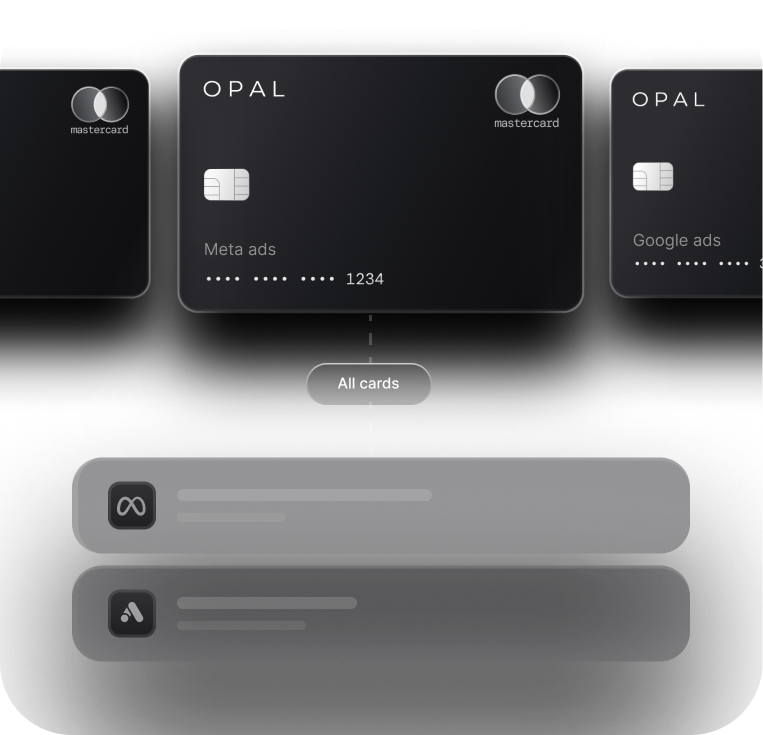
Opal extends credit directly to the agency, sized to your managed spend volume, up to $10M. No client pre-funding, no deposit required. Opal issues virtual cards, one per client per platform, each with a spend limit tied to the approved budget. Each card carries a spend limit aligned to the approved budget, which adds a control layer on top of platform-level caps and reduces the risk of unplanned overages.
Because Opal extends credit directly to the agency, sized to your managed spend volume, you run client campaigns on Opal's credit line rather than your own operating capital.
The card-per-client-per-platform setup maps to the pre-launch checklist items this way:
Checklist item |
How Opal supports it |
|---|---|
Approved budget |
Spend limit set on the card at issuance; campaigns can't exceed what's been approved |
Platform access |
Card number added to each platform's billing section as the active payment method |
Spend limits |
Card-level hard limit runs alongside platform-level budget caps as a second control layer |
Backup payment method |
A second Opal virtual card can be issued per account and held in reserve |
Replenishment trigger |
No manual top-up: Opal's credit line scales with managed spend volume, so campaigns run continuously without the agency initiating a refill |
Opal handles the payment layer. It does not replace the client agreement, the written budget approval, or the access confirmation steps. Those decisions happen before the card goes on the platform.
For agencies managing many clients at once, the card-per-client-per-platform structure also makes spend attribution straightforward without manual allocation. That is covered in the guide on managing ad spend across 50+ clients.
Frequently Asked Questions
What is client-funded ad spend billing?
Client-funded ad spend billing is a billing structure where a dedicated card or account is tied to a specific client's budget, keeping that client's spend separate from the agency's finances. It is a structural model, not a description of how any specific card product works. Opal is a related but distinct tool: Opal extends credit directly to the agency (not the client), sized to managed spend volume, with no client pre-funding or deposit required.
How should agencies bill clients for ad spend?
Agree on the model before onboarding: client-paid direct, agency-paid-and-invoiced, or client-funded. Whichever you use, invoices should separate media spend, management fees, and any credits into distinct line items.
Who should own the ad account when an agency manages campaigns?
The client should own the ad account, with the agency holding admin or advertiser-level access. This preserves campaign history, pixel data, and audience lists if the relationship ends, and keeps the agency out of platform disputes that belong to the client.
What should be confirmed in writing before a campaign launches?
Six items: the approved budget as a specific number, the replenishment trigger for funded accounts, confirmed platform access for every channel in the plan, spend limits set at the platform level, a backup payment method where applicable, and written approval authority identifying who at the client can authorize budget changes.
What is the difference between a management fee and media spend?
Media spend is what ad platforms charge to run ads. Management fees are what the agency charges for its work. They should appear as separate line items on every invoice, so the client can see exactly what they are paying for each.
Should agencies use one card for multiple clients' ad spend?
Avoid using a single card across multiple clients. When one card covers several clients, spend attribution requires manual allocation and a limit issue for one client can affect others. Start with one dedicated payment method per client, then add platform-level cards as volume grows.
.webp)