

Agency Payment Terms for Ad Spend: How to Set Them Before Media Runs

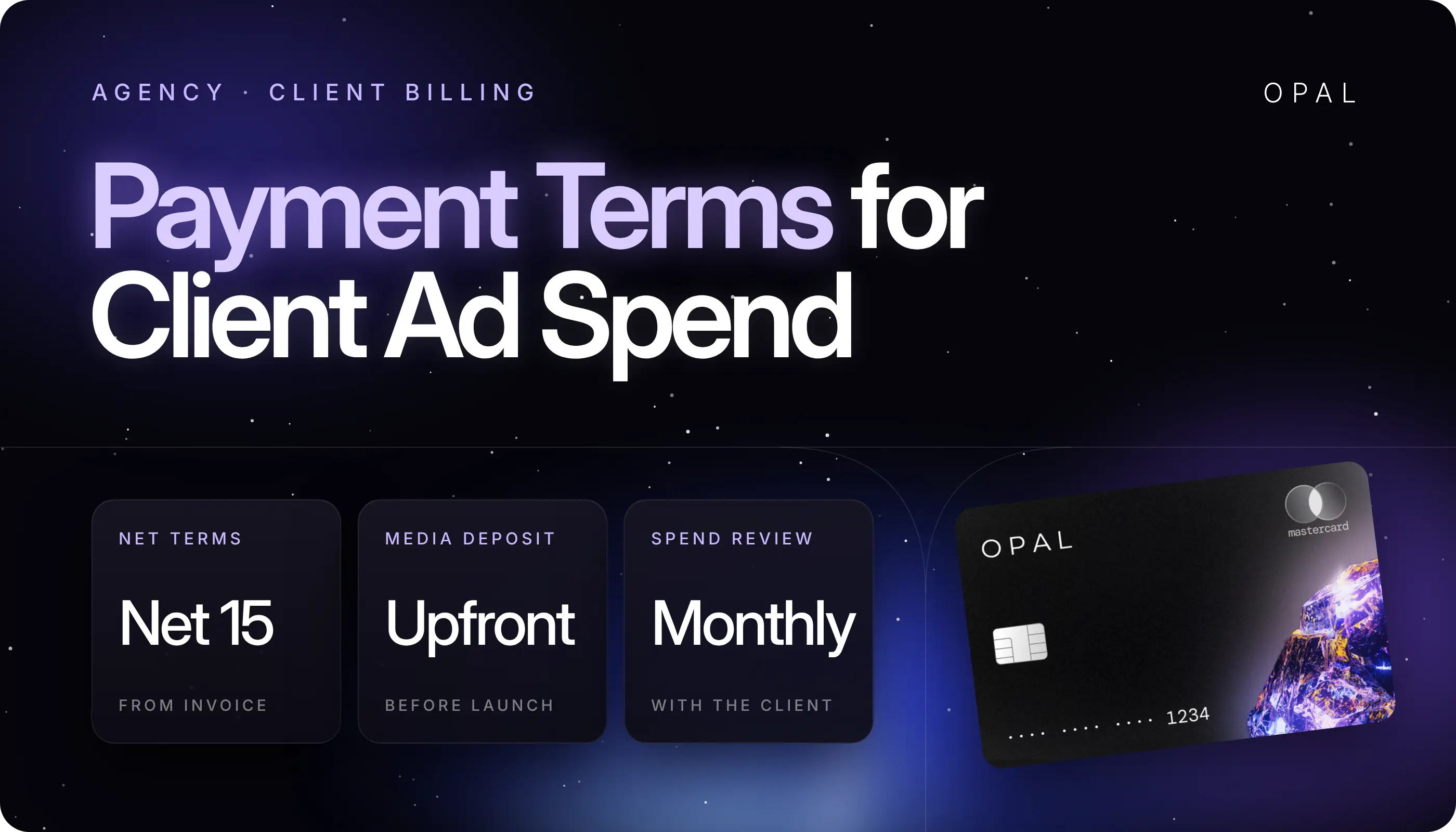
Agency payment terms for ad spend are the contract rules that set when a client pays for media, how much cash you hold before campaigns launch, and what happens when a media invoice goes unpaid.
The reliable way to set them is to align each clause with the date the platform takes your money: the billing basis, the deposit, the invoice cadence, the due date, the reconciliation rule, credits and refunds, the late payment clause, the suspension trigger, the wind-down rule, and media liability, all signed before the first campaign goes live.
These terms matter most to U.S. agencies and media buyers placing client budgets on Google Ads, Meta (Facebook and Instagram), TikTok Ads, LinkedIn Ads, Amazon Ads, and The Trade Desk.
Self-serve accounts on automatic payments charge a card while campaigns run, Google's monthly invoicing gives qualified advertisers payment terms it describes as typically 30 days, and insertion order (IO) buys often follow terms from the American Association of Advertising Agencies (4A's) and the Interactive Advertising Bureau (IAB).
Your client pays on whatever its master services agreement (MSA) or statement of work (SOW) says, and every day between those schedules is a day your agency finances its media.
In this article, you'll learn when to bill media before it runs, how to size a deposit in days of spend, and how to set invoice dates that land ahead of platform due dates. You'll also get a clause-by-clause terms sheet and a notice-then-pause sequence for your next agreement.
Key Takeaways
Payment terms for client media hold up when each client's due date falls before the date your agency pays the platform, card issuer, or media seller for that spend.
Billing media in advance suits new clients, short flights, and any client whose monthly media is large next to your agency's cash on hand.
A media deposit written as days of planned spend, plus a margin for over-delivery, covers the campaigns still running between a missed due date and a pause.
Invoicing media on the approved plan and reconciling it against platform billing records each month keeps advance billing accurate and easy for clients to check.
Insertion order (IO) buys under the American Association of Advertising Agencies (4A's) and Interactive Advertising Bureau (IAB) terms run on a 30-day payment date, so client cash needs to clear inside that window.
What Should Agency Payment Terms for Ad Spend Cover?
They should cover every point where cash changes hands for media: who pays, when, how much you hold in reserve, and what happens when payment stops. Keep them in their own schedule, apart from your fee terms.
Separate Media Terms From Fee Terms
Your fee is revenue, while media passes through to a platform or seller. On a combined invoice, one disputed fee line can hold back the whole payment, so marketing agency payment terms for media spend should give media its own invoice and a stricter due date.
Start From a Clause-by-Clause Terms Sheet
The table below lists the clauses a media payment schedule usually needs, what each decides, and a starting position to adjust per client:
Clause |
What It Decides |
Starting Position |
|---|---|---|
Billing basis |
Whether media is billed before or after it runs |
Advance billing on the approved monthly plan for new clients |
Media deposit |
Cash held against missed payments and over-delivery |
Days of planned spend, stated in the SOW |
Invoice cadence |
How often media is invoiced |
At least as often as the platforms charge you |
Due date |
When client cash must land |
Before your own payment date for that client's media |
Reconciliation |
How planned and actual spend are matched |
Credit or bill the difference on the next invoice |
Credits and refunds |
Who keeps platform credits and refunds |
Passed through to the client on the next invoice |
Late payment |
When an invoice is late and what lateness costs |
A short grace period, plus any charge counsel approves |
Suspension |
When spend is reduced or paused |
Written notice, then a pause on a fixed date |
Wind-down |
Who pays for spend billed after a pause or exit |
The client pays for all media delivered through the pause |
Media liability |
Who a media seller pursues on unpaid IO buys |
Cleared-proceeds wording kept on every IO |
When Should an Agency Require Payment Before Media Runs?
Require payment up front whenever a platform will charge you before the client's normal terms bring cash in, and the client hasn't yet built a payment record with you. That covers most new clients and any account where spend runs on a card.
Compare Charge Dates With Client Due Dates
Each way of paying for media sets a different date for your cash to leave, and a matching client term:
How You Pay for the Media |
When Your Cash Leaves |
Client Term That Keeps You Covered |
|---|---|---|
Automatic payments on a card |
While campaigns run, often several times a month as spend crosses a billing threshold |
Advance billing or a deposit, since charges land before any invoice in arrears |
Google Ads monthly invoicing |
Invoice emailed by the 5th business day, with payment terms typically 30 days |
Monthly billing in arrears, due well before Google's date |
IO buys under 4A's/IAB terms |
30 days from receipt of the seller's invoice, unless the IO sets a schedule |
A client due date inside that 30-day window |
Your own card paying the platforms |
Your card's statement due date |
Client payment due before that statement |
Google lists its monthly invoicing requirements: a business registered for at least 1 year, an account in good standing for 6 months, and $5,000 a month in spend for any 3 of the last 12 months.
Until an account qualifies, it bills a payment method, and our explainer on Meta billing thresholds shows how those charges step up as spend grows.
Default to Advance Billing for Higher-Risk Clients
Advance billing means you invoice the approved media plan before the period starts and launch once it's paid. Make it the default when any of these apply:
The client has no payment history with your agency.
The flight is short or one-off, such as a product launch.
One month of the client's media is more than you could absorb unpaid.
Clients who pay on time can earn billing in arrears later. Write that path into the SOW, with your right to switch back after a late payment.
How Big Should an Ad Spend Deposit Be?
Size the deposit to cover the media still running between a missed due date and the day your contract lets you pause, plus a margin for over-delivery. Writing it in days of planned spend keeps it accurate as budgets change.
Work Out the Deposit in Days of Spend
Say a client approves a $45,000 monthly plan, about $1,500 a day, billed in advance and due on the 1st. Your contract allows 3 days of grace, sends written notice on the 4th, and pauses spend on the 10th, so up to 10 days of media, or $15,000, could run unpaid.
Add 10% of the month, $4,500, for over-delivery and charges billed after the pause, and the deposit comes to $19,500.
For a client billed in arrears, also add the days between each platform charge and the client's due date. That makes the deposit far larger, another reason advance billing suits new accounts.
Spell Out How the Deposit Works
An ad spend deposit agreement needs 4 lines in the SOW: the amount and its formula, how you apply it to past-due invoices, the days the client has to top it up, and when you return it. Add a resize trigger, for example a recalculation whenever the monthly plan changes by more than 20%, and ask your accountant how to record deposits you hold.
How Often Should You Invoice Clients for Media Spend?
Invoice media at least as often as the platforms take your money, and set each due date ahead of your own payment. For most accounts that means a monthly advance invoice with a reconciliation, or weekly invoices for heavy spenders on card payments.
Bill the Plan, Then Reconcile to Actuals
Advance invoices use the approved plan, so they rarely match actual charges. At month end, pull each account's billing records, such as the transaction history on the Google Ads Billing page or the billing history in Meta Ads Manager, and put the difference on the next invoice.
Platform credits and refunds flow through the same way, and our guide to pre-launch billing setup shows how to lay out those lines.
Set Due Dates Backward From Your Payment Date
Count back from the date you pay for the client's media, so client ad spend reimbursement always lands first. On Google monthly invoicing, a Google invoice arriving by the 5th business day with 30-day terms leaves room for a client invoice issued on the 3rd at net 15, due around the 18th.
When a card pays the platforms, set the client's due date at least 5 business days before your statement is due.
What Should a Late Payment Clause for Agencies Say?
A late payment clause should define when a media invoice counts as late, what lateness costs, and what you may do next, in order. Writing it down before launch means nobody negotiates it mid-campaign.
Define the Grace Period and the Charge
Name a short grace period, such as 3 days, after which the invoice is late. Any late charge or interest generally needs to be in the signed agreement and within the governing state's legal limits, so have counsel draft it. Two other rights protect your cash faster: applying the deposit, and moving the client to advance billing.
Tie the Clause to Your Credit Exposure Policy
Your agency credit exposure policy decides which clients get which terms, and the late payment clause is where that policy meets the client. Keep the clause identical for clients on the same terms, and route exceptions through one person in finance. Our late-payment credit policy guide covers measuring exposure and sizing a reserve.
When Should Campaigns Pause for Nonpayment?
Pause on a date your contract fixes in advance, after written notice, and before the deposit stops covering the media still running. That keeps the pause predictable for both sides.
Write a Notice-Then-Pause Sequence
Put these steps into the SOW in this order:
When the grace period ends, send written notice naming the open invoices, amount due, and pause date.
Partway to the pause date, cut daily budgets to what the remaining deposit covers.
On the pause date, pause every campaign on the client's accounts and record the time.
Apply the deposit to the oldest open media invoice, and bill the client to restore it.
Pausing on your schedule keeps the decision yours. Fall behind with a platform and it sets the timing: on monthly invoicing, Google says ads may be slowed or stopped if you exceed your payment terms or credit line.
Bill Spend That Lands After the Pause
A pause stops new delivery, but charges for media already delivered can still post afterward. Write that the client owes all media delivered up to the pause, whenever it's billed, and that campaigns restart once open invoices clear and the deposit is restored. If a client goes silent, work through our steps for recovering unpaid media.
How Do Agency Media Buying Payment Terms Work for Insertion Orders?
Insertion order buys often follow a schedule set by the IO or by standard terms both sides accept. Your client terms need to bring cash in before that schedule comes due.
Match Client Due Dates to the IO Payment Date
Under Version 3.0 of the 4A's/IAB standard terms, the media company first invoices after the first month's delivery, or sooner for a short IO. The agency pays 30 days from receiving it unless the IO sets another schedule, and the media company can give notice of nonpayment and seek payment from the advertiser 5 business days later. Set the client's due date well inside those 30 days.
Keep Cleared-Proceeds Wording on Every IO
The same terms hold the agency liable "solely to the extent proceeds have cleared from Advertiser to Agency," and the advertiser solely liable for the rest.
That applies unless the agency states otherwise on the IO, so read each IO before signing. Self-serve platforms work differently, since the payment method on the account carries the charge, as our guide to fronting spend without liability explains.
Put Each Client's Media on Its Own Opal Card
Payment terms decide when clients pay you, and your card decides how you pay the platforms meanwhile. We provide the Opal Card, a charge card built for advertising spend, so each client's media can run on its own card and limit.
See What Every Account Includes
We provide unlimited virtual cards at no cost, each with its own spending limit, expiration date, and merchant restrictions, plus approvals and employee permissions.
Card-level spend visibility and QuickBooks sync give you the records your monthly reconciliation needs. Credit is sized on your advertising spend, subject to underwriting, and eligible ad spend earns up to 1.5% cashback, with your rate confirmed at approval. There's no annual fee, no personal guarantee, and no hard credit check.
Check the Fit Before You Apply
You configure the cards and limits, and you still invoice and collect from each client. The Opal Card is a pay-in-full charge card: the full statement balance is debited automatically on each due date, and a failed debit can block the card. It's for U.S.-based businesses on supported advertising and media platforms, so most teams keep a general business card for other expenses.
Ad Pay, our separate product for Meta and Google invoices, carries a 3% processing fee on Opal credit or 3.5% on another card and is currently taking waitlist sign-ups.
The application takes 2 to 3 minutes, and virtual cards usually arrive within 24 to 48 hours. See the setup on Opal for agencies, then apply from our site or book a demo.
Frequently Asked Questions (FAQs)
What Payment Terms Should an Agency Set for Client Ad Spend?
An agency should set payment terms for client ad spend that bring cash in before it pays the platform or media seller. Common structures include advance billing on the approved monthly plan, a deposit sized in days of planned spend, short due dates for established clients, and a written notice-then-pause sequence.
Is an Ad Spend Deposit Refundable When a Client Leaves?
An ad spend deposit is refundable when the agreement says so, after the final reconciliation. The agency applies it to open media invoices and to charges billed after the last pause, then returns the rest within a set number of days. Write that timing and the order of deductions into the statement of work.
Can an Agency Pause a Client's Campaigns for Nonpayment?
An agency can pause a client's campaigns for nonpayment when the signed agreement gives it that right and the agency follows the notice steps it sets out. Name the grace period, written notice, and pause date in the statement of work, and have counsel review the clause so the pause can't be argued as a breach.
How Should an Agency Bill Clients After Google Ads Moves to Monthly Invoicing?
When a Google Ads account moves to monthly invoicing, Google emails an invoice by the 5th business day of the month, with payment terms it describes as typically 30 days. The agency can then bill the client monthly in arrears for actual spend, as long as the client's due date falls well before Google's.
Who Pays the Media Seller If a Client Never Pays the Agency?
That depends on the buy. Self-serve platforms charge the payment method on the ad account, so the agency's card carries the cost. Under the 4A's and Interactive Advertising Bureau standard terms for insertion order buys, the seller holds the agency liable only for money cleared from the advertiser, unless the order says otherwise, and pursues the advertiser for the rest.
Agency Ad Spend Management: How to Run Client Media Without Sharing Credit Cards

Client-Facing Ad Spend Reports: Agency Guide

Automate Meta Invoice Reconciliation: An Agency Guide to Matching Rules and Exceptions