

Meta and Google Ads Invoice Payments vs. Card Payments: Fees, Cashback, and Cash Flow Compared

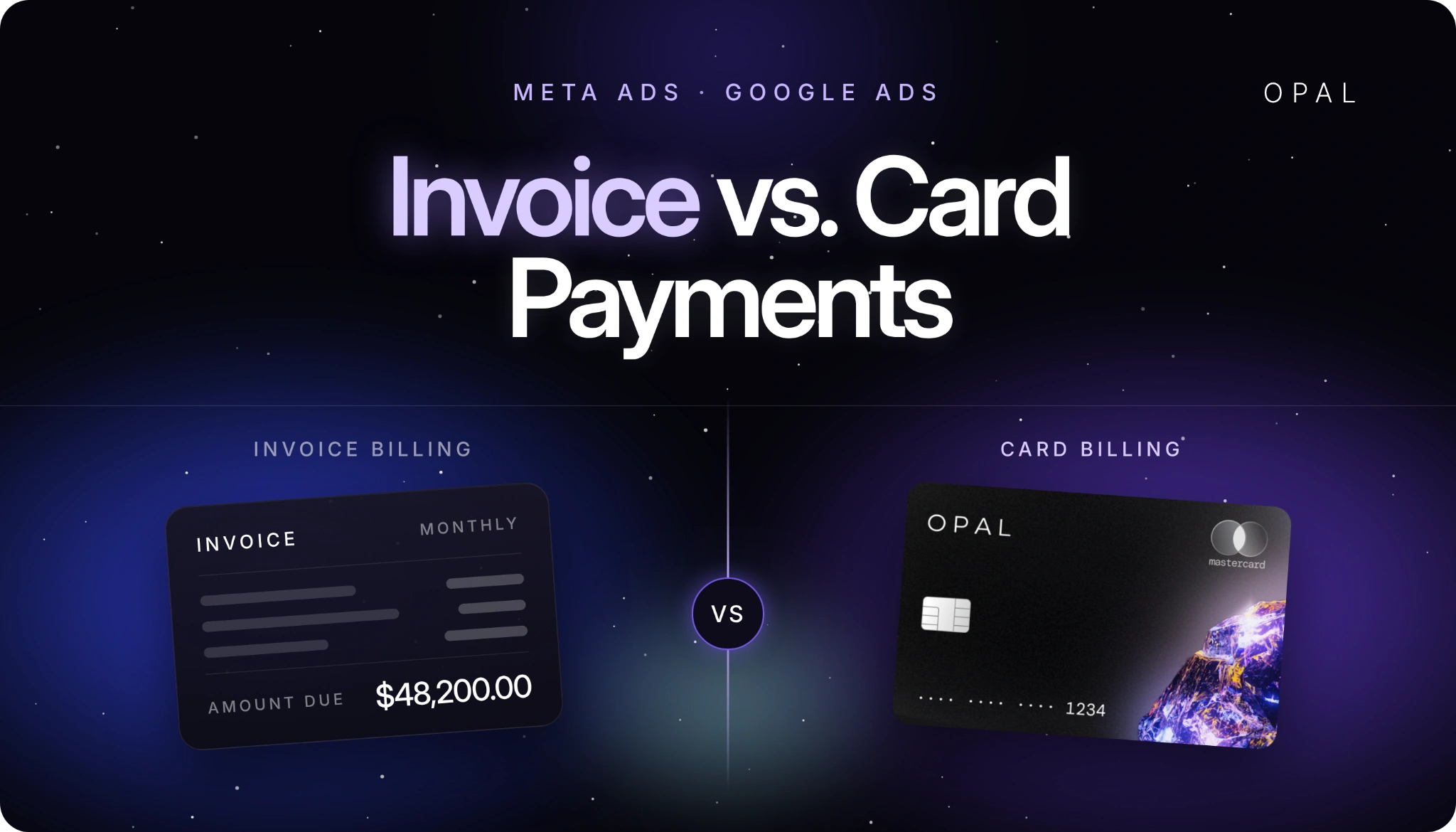
Meta and Google Ads invoice payments settle a month of advertising against a platform credit line by bank transfer on a fixed due date, while card payments charge a card on file automatically as spend builds.
Which one leaves your business better off comes down to 3 figures you can pull from your own books: the fee to pay, the rewards you keep, and the number of days before cash leaves your account.
The choice is rarely yours to make freely. Google Ads offers monthly invoicing to businesses that meet its spend and history criteria, and Meta has moved a small share of its largest advertisers off credit cards and onto monthly invoicing or direct debit.
For U.S. agencies running client media, ecommerce brands, and in-house growth teams, that move swaps a card's statement cycle and rewards for a 30-day bill paid from the bank account, often before the client's own payment arrives.
In this article, you'll see how each payment method compares on eligibility, timing, fees, and rewards, with a worked cost example on a $100,000 invoice. You'll also learn how to map invoice due dates against client payments and how to decide when a card-funded invoice service is worth its fee.
Key Takeaways
- Google states that it doesn't accept credit card payments on monthly invoicing accounts, so paying a Google Ads invoice by card requires a third-party invoice payment service.
- Meta advertisers moved to monthly invoicing pay each invoice 30 calendar days after the invoice date, by direct debit or bank transfer, according to Payments Dive's reporting on the change.
- A bank transfer on the due date usually carries no processing fee from the platform, but it earns no card rewards and moves cash out on the platform's schedule.
- A card-funded invoice service charges a percentage fee, so a 3% fee on a $100,000 invoice costs $3,000 before any rewards the card earns.
- The fee is worth paying when the extra days of cash cost less than your next-best source of short-term funding, or when a late payment would pause campaigns.
How Do Meta and Google Ads Invoice Payments Compare With Card Payments?
Invoice payments cost less to process and give you a known due date, while card payments add a statement cycle and rewards but depend on the platform still letting you pay by card. A card-funded invoice service sits between the two, keeping the invoice relationship with the platform while moving your outflow onto a card.
Compare the 3 Payment Routes Side by Side
Here is how the 3 routes differ on the points finance teams ask about first:
| Automatic card charges | Bank transfer on a platform invoice | Card-funded invoice service | |
|---|---|---|---|
| Who can use it | Accounts the platform still bills by card | Accounts approved for, or moved to, monthly invoicing | Invoiced accounts the service supports |
| When cash leaves your account | On your card's statement due date | On or before the invoice due date | On your card's statement due date, after the service pays the platform |
| Processing fee | None charged by the platform | None listed by the platform; your bank's wire fee may apply | A percentage of each invoice, set by the service |
| Card rewards | Whatever your card program pays on eligible spend | None | Depends on the card used and whether its terms count the charge as eligible |
| Who owes the platform | Your card is charged automatically | You, by the due date | You, with the service paying on your behalf |
Who Carries the Risk in Each Route
On automatic billing, the platform charges your card and your issuer approves or declines it, so a declined charge leads the platform to pause delivery. On an invoice, the platform waits for your transfer, and a missed due date becomes your problem directly. A card-funded service adds one more party, which means its processing time has to fit inside the platform's due date.
How Do Meta and Google Decide Whether You Pay by Card or Invoice?
Each platform sets the billing method by account, based on spend and history, and large advertisers are increasingly placed on invoicing. Your payment options follow from that setting rather than the other way around.
Automatic Card Billing on Thresholds and Bill Dates
Most advertisers start on automatic payments. Google's postpay setting charges your card on the first day of each month or when the account reaches its threshold, whichever comes first, and Meta charges at a payment threshold and again on a monthly bill date. Our guide to invoice due-date cash flow covers how those charge dates stack up across accounts.
Google's Monthly Invoicing Credit Line
Google provides a line of credit, sends a monthly invoice, and expects repayment on the terms agreed at enrollment. Its help page says you may be eligible as a business registered for at least 1 year with at least $5,000 of spend in any 3 of the last 12 months, and you apply through your account manager or Google's request form.
Meta's Move Away From Cards for Large Spenders
Meta began notifying a small group of advertisers that they would stop paying by credit card and move to monthly invoicing or direct debit. Payments Dive's report on the change describes a credit line that caps total spend across ad accounts and WhatsApp business accounts, with payment due 30 calendar days after each invoice date.
Once the line is used up, Meta pauses those accounts until a payment posts or the limit rises, and invoice-level records come with matching work of their own, covered in our guide to Meta invoice reconciliation.
Can You Pay Meta and Google Ads Invoices With a Credit Card?
Not directly on Google, and not on Meta once your account has moved off card billing. On an invoiced account, card payment runs through a third-party service that charges your card and pays the platform.
What Google Accepts on an Invoice
Google's page on paying monthly invoicing accounts says most invoiced advertisers settle by wire transfer or check and states plainly that it doesn't accept credit card payments.
Each payment needs your Google invoice number and any credit memo numbers, or Google may apply it to your oldest charges. U.S. advertisers can also pay online from a bank account in Google Ads, and Google notes that processing can take up to 5 business days. Our walkthrough on automating ad invoice payments shows where those references go.
How Card-Funded Invoice Services Work
A card-funded service reads or receives the platform invoice, charges the amount plus a processing fee to the card you choose, and sends payment to Meta or Google.
You still owe the platform by the due date, so ask each provider 3 questions before you sign up. How many business days does the payment take to reach the platform? Which card can you fund it with? And does that card's program count the charge as eligible for rewards, or code it as a payment service?
What Does Each Payment Method Cost on a $100,000 Invoice?
On fees alone, a bank transfer is the cheapest route, and a card-funded service costs its fee minus whatever rewards the card returns. The real comparison sets that net fee against what the extra days of cash are worth to you.
Run the Fee Math First
Say your agency receives a $100,000 Meta invoice, an example figure. Paying it by wire costs whatever your bank charges for an outgoing wire. Routing it through a service that charges 3% costs $3,000, and a 3.5% fee costs $3,500. Each percentage point of rewards the card returns on that charge is worth $1,000, so the net cost depends on the card's terms rather than the headline fee.
Price the Extra Days Against Your Alternatives
The fee buys time between the platform's due date and the day your card statement is paid. Say your alternative is drawing $100,000 on a business line of credit at 10% a year, an example rate, for 55 days.
That draw costs about $1,507 in interest ($100,000 × 10% × 55 ÷ 365), well below a $3,000 fee. If you have no line available, or the client's payment lands after the invoice is due, the comparison shifts toward the service.
Count Rewards on Both Sides
Rewards matter most on accounts Meta or Google still bill by card, since those charges carry no processing fee. Your card's full rewards rate applies with nothing to offset, which makes card billing worth keeping wherever the platform allows it.
How Does Payment Timing Change Agency Cash Flow?
Timing decides whether your agency pays the platform with the client's money or its own. An invoice due 30 days after issue and a client on net 45 terms leave a gap you carry every month.
Map the Dates for One Client Month
Say your agency runs $100,000 of a client's Meta spend in a month, an example figure, with the client on net 45 terms. Here is how the dates fall from the day the month closes:
| Day | What happens | Cash position |
|---|---|---|
| 0 | Month closes and spend is final | $100,000 owed to Meta |
| 1 | Meta issues the invoice | Due on day 31 |
| 3 | You invoice the client on net 45 | Client payment due day 48 |
| 24 | You send payment, allowing up to 5 business days to process | Bank balance reserved |
| 31 | Meta invoice due | $100,000 out of your account |
| 48 | Client pays on time | $100,000 back in |
That leaves 17 days in which your agency funds the client's media. If the client pays 15 days late, the gap grows to 32 days.
Close the Gap in the Contract First
Shortening client terms costs nothing, so start there. Billing media in advance, invoicing weekly, or setting client due dates ahead of the platform's due date each shrink the gap, and our guide to late-paying media clients covers deposits and pause clauses. A card-funded service suits the gap that remains after those changes.
When Does an Invoice Payment Service Make Sense?
A service makes sense when the days it buys are worth more than its net fee, and when a late payment to the platform would cost more than either. Work through your own numbers rather than a general rule.
Signs the Fee Pays for Itself
These situations tend to favor routing an invoice through a card-funded service:
- Client payments routinely land after the platform's due date, and the gap would otherwise come from your operating cash.
- Your bank line is fully drawn, priced above the net fee, or unavailable.
- A paused Meta or Google account would cost a client more in lost sales than the fee costs you.
- You can pass the fee to the client under your contract or build it into your media margin.
Signs a Bank Transfer Is the Better Choice
If cash is on hand and clients pay before the invoice is due, a wire or online bank payment keeps the full amount in your business. The same holds when your card's terms code invoice payments as non-eligible, since the fee then buys time with nothing returned. Check those terms in the card's rewards agreement under excluded transactions before routing a large invoice through it.
Move Meta and Google Invoices Onto Opal Credit With Ad Pay
We built Ad Pay for the accounts Meta and Google have moved to invoicing, and the Opal card for the platforms that still bill by card. Here is what each covers and where each stops.
What We Provide Through Ad Pay and the Opal Card
You connect the inbox where Meta and Google send invoices, Ad Pay detects each one, and you review the amount and due date before choosing to pay with Opal credit or a connected card. We send payment to Meta or Google directly, and payments process in 3 to 5 business days.
The processing fee is 3% using Opal credit and 3.5% using another card, and paying with Opal credit can extend your cash-flow window by up to 55 days, depending on transaction timing and account terms. Our Ad Pay explainer walks through the steps.
For card-billed accounts, we provide the Opal card, a pay-in-full charge card with unlimited virtual cards at no cost, each with its own spending limit, merchant restrictions, and team permissions. It earns up to 1.5% cashback on eligible ad spend, with no annual fee, no personal guarantee, and no hard credit check, and transactions sync to QuickBooks.
Where Ad Pay Fits and Where It Doesn't
You choose which invoices to route through Ad Pay and which to pay by bank transfer, and the transfer stays cheaper whenever cash is already on hand. Ad Pay covers Meta and Google invoices, is open by waitlist, and serves U.S.-based businesses. The Opal card works on supported advertising and media platforms, and its full statement balance is collected automatically on each due date. Applying takes 2 to 3 minutes, and virtual cards usually arrive within 24 to 48 hours. Join the Ad Pay waitlist, or apply for the card from our site and book a demo with our team.
Frequently Asked Questions (FAQs)
What Is the Best Way to Pay Meta and Google Advertising Invoices With a Credit Card?
Google doesn't accept credit cards on monthly invoices, and Meta stops accepting them once an account moves to invoicing. The workable route is a card-funded invoice service that charges your card and pays the platform. Compare each service on its fee, processing days, supported platforms, and whether your card earns rewards on the charge.
Can I Earn Rewards When Paying Meta and Google Ads Invoices?
A bank transfer earns nothing. Paying through a card-funded service can earn rewards if your card's program treats the charge as eligible, so read the excluded-transactions section of your rewards terms first. Weigh any rewards against the processing fee, since a fee above your rewards rate leaves a net cost.
How Long Does an Invoice Payment Take to Reach the Platform?
Google says online invoice payments can take up to 5 business days to process, and checks can take longer than wires. Card-funded services add their own processing time, which for Ad Pay is 3 to 5 business days. Send every payment at least a full business week before the invoice due date.
Who Qualifies for Google Ads Monthly Invoicing?
Google's help page says you may be eligible if your business has been registered for at least 1 year and spent at least $5,000 in any 3 of the past 12 months. Spend on earlier accounts doesn't count toward that. You apply through your Google account manager or Google's payment-setting request form.
Does Paying by Card Change When Meta or Google Expects Payment?
No. The platform's due date stays the same whichever way you pay. A card-funded service pays the platform before that date, and what moves is your own outflow, which shifts to the card's statement due date. Plan the service's processing days back from the platform's due date, not from your statement date.
What Happens if a Meta Invoice Goes Unpaid?
Unpaid invoices keep using your Meta credit line. Payments Dive reported that when the line is fully used, Meta pauses the linked ad accounts and WhatsApp business accounts until a payment is made or the limit is raised. Pay ahead of the due date to keep campaigns delivering through month end.
Opal Ad Pay Explained

Automate Ad Invoice Payments: How Agencies Pay Meta and Google Without Manual Uploads

Automate Meta Invoice Reconciliation: An Agency Guide to Matching Rules and Exceptions