

Programmatic Advertising Billing for Agencies: How to Pay, Track, and Reconcile DSP Spend

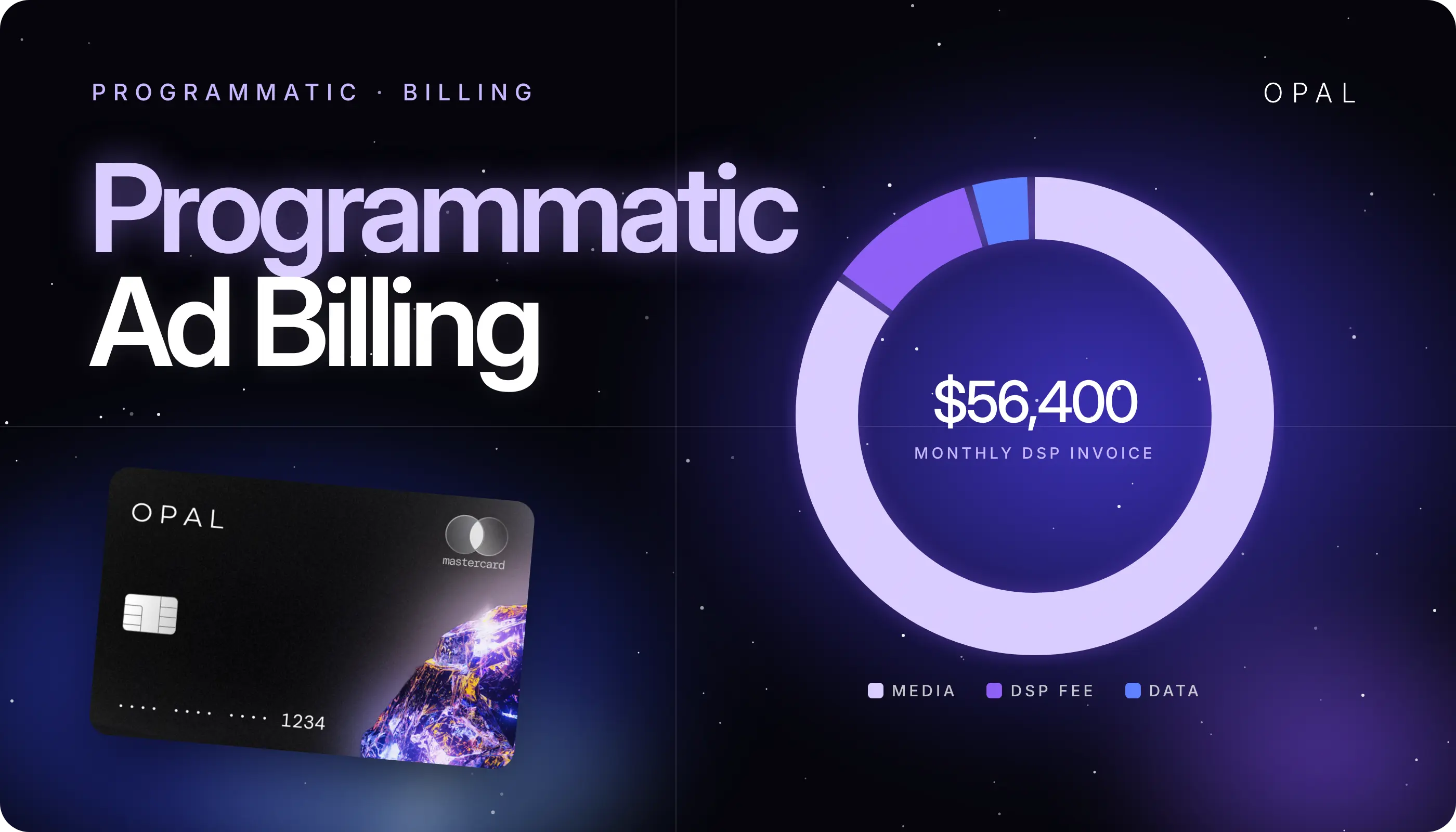
Programmatic advertising billing for agencies is the process of paying for media bought through demand-side platforms (DSPs) and direct insertion orders, then tying every invoice back to the client, campaign, and contract it belongs to.
The reliable way to run it is to map each platform's billing model and accepted payment methods before launch, give every client its own budget and payment line, and reconcile each invoice against platform reporting at month end.
This guide is for agencies, media buyers, and in-house growth teams buying display, video, and connected TV (CTV) inventory through Google Display & Video 360 (DV360), Amazon DSP, or The Trade Desk, or direct from publishers on an insertion order (IO).
Unlike Meta and Google Ads, programmatic invoices arrive after the month closes, bundle media with platform, data, and third-party fees, and sometimes can't go on a card.
For direct buys, standard terms from the Interactive Advertising Bureau (IAB) and the American Association of Advertising Agencies (4A's) still shape invoicing and agency liability.
In this article, you'll learn how programmatic billing differs from social and search billing, which payment models DSPs and CTV deals use, and where liability sits when a client pays late. You'll also see how to set campaign controls, reconcile DSP invoices line by line, and report programmatic spend by client.
Key Takeaways
Programmatic platforms usually bill after delivery, and Google Display & Video 360 (DV360) sends its invoice on the first day of each month for the previous month's billable spend.
Accepted payment methods vary by demand-side platform (DSP), and DV360 invoices can't be paid by credit card, so check each platform's billing terms before you choose how to pay.
Under the Interactive Advertising Bureau (IAB) and American Association of Advertising Agencies (4A's) standard terms, sequential liability limits an agency's payment liability to funds cleared from the advertiser, unless the insertion order (IO) says otherwise.
A DV360 invoice total equals its positive line items (media cost, platform fees, data fees, and third-party fees), minus refunds, plus taxes, which gives you a formula to reconcile against.
Client-level separation is set up before launch through billing profiles, purchase order (PO) numbers, and one budget and payment line per client.
How Does Programmatic Advertising Billing for Agencies Work?
Programmatic media is billed by whoever holds the inventory contract: the DSP when you buy through a platform, or the publisher on a direct IO. Both usually invoice monthly, after delivery.
Two Buying Paths, Two Billing Relationships
A DSP aggregates inventory from many exchanges and sends one invoice for media, fees, and data. Google's guide to how DV360 billing works explains that your contract with Google sets the rates and payment terms, which vary by country.
A direct buy, such as a CTV placement from a streaming publisher, is billed under the IO. An IO that adopts the IAB/4A's template has the media company invoice each calendar month at net cost.
When the Invoices Arrive
DV360 generates each invoice on day 1 of the following month, so a 3-month campaign produces 3 invoices. Under the IAB/4A's template, the first invoice follows the first month of delivery, or comes within 30 days of the IO's completion if that is sooner.
Either way, you commit media weeks before you see the bill. October delivery is invoiced in early November and paid later still, so cash planning has to cover a full month plus the payment window.
How Is DSP Billing for Agencies Different From Social and Search Billing?
The difference is timing and payment method. Social and search platforms charge a card as spend accrues, while DSPs and publishers mostly invoice after delivery and get paid by transfer under contract terms.
Billing factor |
Meta and Google Ads |
DSPs such as DV360 |
Direct CTV or publisher IO |
|---|---|---|---|
When you're charged |
At a billing threshold or on a monthly cycle |
Monthly invoice after delivery |
Monthly invoice after delivery |
Typical payment method |
Card on file, or invoicing for larger accounts |
Varies by platform; DV360 takes wire, check, or bank transfer |
Set by the IO |
Who sets the terms |
The platform's billing settings |
Your contract with the DSP |
The IO and any standard terms it adopts |
What's on the bill |
Media spend |
Media, platform fees, data fees, third-party fees |
Net media cost per the IO |
Thresholds Versus Monthly Invoices
On Meta and Google Ads, a charge fires each time spend crosses your threshold, so a card's limit decides whether ads keep running. Our explainer on ad platform billing mechanics covers those rules.
Programmatic invoices collapse a month of activity into one bill. The risk shifts from a mid-flight decline to a large sum due on a fixed date.
Programmatic Media Payment Methods by Platform
Confirm payment methods on each platform's billing help page before launch. Google states that DV360 invoices can't be paid by credit card. Amazon Ads' update on advertiser payments describes Pay by Invoice as a month-end invoice due 30 days later, with an existing card kept as a backup method. For The Trade Desk, our guide to Trade Desk billing terms covers what to check in the platform agreement.
Which Payment Models Do DSPs and CTV Deals Use?
Most programmatic spend runs postpaid, invoiced after delivery on contract terms. Prepaid and balance-deduction models appear when a platform's default calls for them or a seller asks for payment up front.
Postpaid Invoicing on Contract Terms
Postpaid is the norm for DV360 and for direct IO buys. Under the IAB/4A's template, the agency pays 30 days from receipt of the invoice unless the IO sets a different schedule, and the media company should provide proof of performance on request.
Write down 3 numbers for each platform: the invoice date, the payment window, and the credit it has extended to you. Together they show how much media you can carry before clients pay.
Prepaid and Balance-Deduction Models
The IAB/4A's terms let a media company require payment in advance if the advertiser's or agency's credit becomes impaired. Amazon Ads has moved a small number of advertisers to deduction from their seller or vendor account balance as the default payment method. If you run Amazon DSP for an ecommerce client, our Amazon Ads invoicing guide explains how those invoices reach the agency.
CTV Advertising Billing on Insertion Orders
CTV bought through a DSP lands on the DSP's monthly invoice alongside display and video. CTV bought direct follows the IO, so its payment schedule, cancellation notice, and measurement source are whatever that document says.
Read those 3 clauses before signing. The IAB/4A's template, for example, allows cancellation without penalty on 14 days' written notice for guaranteed deliverables and 7 days for non-guaranteed ones, unless the IO marks the buy as non-cancelable.
Who Is Liable When a Client Pays Late?
On direct IO buys that adopt the IAB/4A's terms, the agency is liable only for funds it has received from the advertiser. On a DSP contract, liability follows whatever that contract says.
How Sequential Liability Works
Section III(c) of the IAB/4A's standard terms holds the agency liable for payment solely to the extent proceeds have cleared from the advertiser, the principle known as sequential liability. For sums that haven't cleared, the media company looks to the advertiser as the agency's disclosed principal.
The same section establishes agency credit client by client. If the media company hasn't been paid, it may notify the agency and seek payment from the advertiser 5 business days after that notice.
Check the Liability Language in Your Own Contracts
Open each IO and platform agreement and find the payment liability clause. Look for wording like "solely to the extent proceeds have cleared," then check whether the IO overrides it.
If a DSP contract names your agency as payer with no such clause, treat that media as agency debt until paid. Size payment capacity to your largest expected monthly invoice, not the average.
How Do You Set Campaign Controls Around Programmatic Spend?
Set controls in 2 places: budgets inside the DSP or IO that cap delivery, and payment lines outside it that keep clients separate. Neither replaces the other.
Match Budgets to the Billing Period
Set budgets by calendar month, the period DSP invoices and IAB/4A's-style IOs bill on. Google's help page on invoices and adjustments notes that DV360 automatically credits back delivery beyond a monthly budget, so the budget also flags those credits.
Record each client's approved budget, the platform budget you configured, and the PO covering it. When those 3 figures match, an invoice above them stands out.
Separate Payment Lines by Client
DV360 lets a partner admin manage billing profiles that control who pays, the PO number, invoice options, and email recipients. Give each client its own profile, or at least its own PO, so invoices arrive already sorted.
Where a platform accepts cards, a dedicated card per client with its own limit does the same job. One shared card turns a single large invoice into every client's problem.
How Do You Reconcile DSP Invoices Against Reporting?
Rebuild each invoice from its line items, then pull a report matching the invoice month, level, and currency. Google's guide to comparing invoices with reporting sets out this method for DV360.
Rebuild the Invoice Total From Line Items
In DV360, the invoiced amount, reported as Billable Cost, equals the sum of the positive line items: Media Cost, Platform Fee, Platform Add-On Fee, Data Fees, and Third Party Fees. Refunds appear as negative lines, and total cost equals Billable Cost minus refunds plus taxes.
For example, say a client's October invoice shows $40,000 in media cost, $4,000 in platform fees, $2,500 in data fees, and $500 in third-party fees. Billable Cost is $47,000, and a $300 refund line brings total cost to $46,700 before tax.
Explain the Gaps Before You Close the Month
Small differences can come from data freshness and currency rounding, and Google treats the invoice as the amount owed. Take tax from the invoice, since DV360 reporting omits it.
Invalid traffic adjustments need their own line, because Google applies those credits to future advertising rather than refunding them. Our ad spend reconciliation guide shows a month-end template you can extend with these entries.
How Should Agencies Report Programmatic Spend to Clients?
Report the full billable cost by client, with identifiers that tie each figure to an invoice. Clients who see only media cost will question a higher invoice total.
Tag Every Invoice With Client Identifiers
Capture the IO number, advertiser name, and campaign name, which the IAB/4A's template lists as details agencies can require. Add the PO number and billing profile for DV360, and use Amazon DSP's billing center, where an entity can filter invoices by linked advertiser.
Keep those identifiers in the same columns every month, so any figure a client questions traces to its invoice line in one lookup. That consistency also speeds up month-end close.
Show the Fee Layers Clients Pay For
Break programmatic spend into media, platform fees, data, and third-party costs. For layout, start from our client-facing spend reports guide and add one block for credits carried between months.
A revenue markup added in DV360 doesn't appear on Google's invoice. Report it separately so the client's total reconciles with what your agency bills.
Put Card-Eligible Programmatic Spend on Opal
Programmatic spend splits into what a platform lets you pay by card and what it takes only by transfer. We built the Opal card for the first group.
See What Every Account Includes
Opal is our pay-in-full charge card for advertising spend, and every account can issue as many virtual cards as it needs, free. You organize cards by client, platform, or campaign, and set each one's spending limit, expiration date, merchant restrictions, and employee permissions.
Eligible ad spend earns up to 1.5% cashback. There's no annual fee, no personal guarantee, and no hard credit check, credit is sized on your advertising spend subject to underwriting, and transactions sync to QuickBooks with card-level spend visibility by client.
Check the Fit Before You Apply
You set up and assign the cards. They work on supported advertising and media platforms, including The Trade Desk and Amazon Ads, where the platform accepts cards, so invoice-only platforms such as DV360 stay on transfer.
The full statement balance is collected automatically each monthly due date, and a failed payment can lock the card.
Opal serves U.S.-based businesses only. Ad Pay, our separate product for Meta and Google Ads invoices, is on a waitlist and charges a 3% fee on Opal credit or 3.5% on another card.
The application form takes 2 to 3 minutes, with virtual cards usually issued within 24 to 48 hours. Read our page for agencies, then apply or book a demo.
Frequently Asked Questions (FAQs)
Can You Pay a DSP With a Credit Card?
It depends on the platform. Google Display & Video 360 invoices can't be paid by credit card and accept wire transfer, check, or bank transfer instead. Amazon Ads keeps a card on file as a backup payment method in some setups. Check each platform's billing help page and your contract before planning card payments for programmatic media.
How Does CTV Advertising Billing Work for Agencies?
Connected TV bought through a demand-side platform appears on that platform's monthly invoice with other programmatic media. Connected TV bought directly from a streaming publisher follows the insertion order, which sets the payment schedule, cancellation notice, and measurement source. Where the order adopts the IAB/4A's standard terms, payment is due 30 days from invoice receipt.
What Is Sequential Liability in Media Buying?
Sequential liability is a contract term that limits an agency's payment liability to money it has received from the advertiser. Under the IAB/4A's Standard Terms and Conditions, the media company seeks unpaid sums from the advertiser directly. It applies only where the insertion order adopts those terms, so DSP agreements in the agency's name often work differently.
Why Doesn't My DSP Invoice Match the Platform Report?
Mismatches usually come from report settings or timing. In Display & Video 360, match the report's date range to the invoice month, its dimensions to the billing profile's invoice level, and its currency to the invoiced currency. Small remaining gaps can come from data freshness and currency rounding, and taxes appear only on the invoice.
How Often Do Programmatic Platforms Send Invoices?
Most send one invoice per month after delivery. Display & Video 360 issues its invoice on the first day of each month for the previous month's spend, and a multi-month campaign gets a separate invoice for each month. Amazon Ads' Pay by Invoice option sends a month-end invoice with payment due 30 days later.